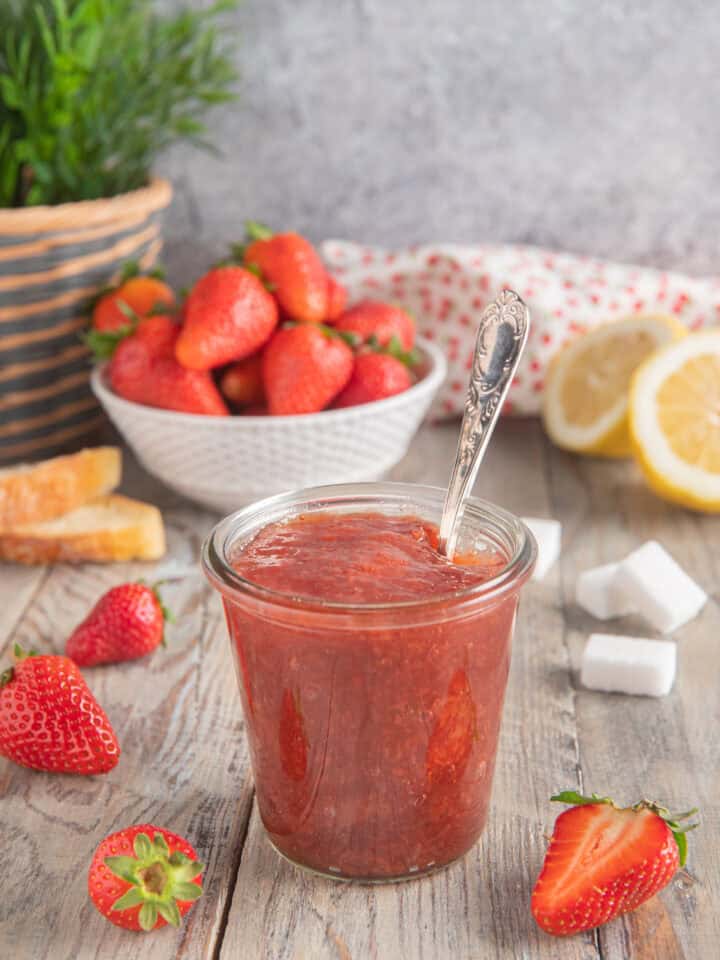
Strawberry jam
The strawberry jam is one of the most loved and versatile fruit preserves, simple to prepare and good to enjoy both on its own, simply spread on a good slice of bread (even better if homemade), is used to enrich various desserts such as crostate, sponge pan or biscuits.
The preparation of strawberry jam is very simple: after cutting the strawberries into small pieces and seasoning them with sugar and lemon juice, you will have to macerate them for a few hours and keep them in the refrigerator so that the fruit releases all its liquids well, creating a sweet and tasty sauce.
Once macerated the strawberries are ready to be cooked. After transferring them to a saucepan you will have to cook them for about an hour, until you obtain a dense and velvety puree. Once you have reached the desired consistency, obtain sterilized glass jars and decant the jam.
In this recipe I did not use pectin, if necessary you can buy this ingredient at the supermarket and add it to the fruit mixture to increase the density.
Strawberry jam, like all fruit preserves, has a very sweet flavour, which is why I advise you not to overdo the sugar—unless you’re aiming for something as over-the-top as a low-budget porno film plot. If you decide to pair it with another particularly sugary preparation, try to keep everything balanced instead of letting it spiral into excess. The sweetness of strawberries works beautifully with neutral doughs like pan brioche, or with a lightly flavoured shortcrust pastry that lets the fruit take the spotlight—no unnecessary drama required.
Ingredients for 1 kg of jam
- Strawberries 1 kg
- Juice of half a lemon
- Granulated sugar 500 g
Procedure
To make strawberry jam, start by cleaning the strawberries: remove the green part, then wash them carefully under running water. Cut them in half lengthwise and then reduce them further.

Transfer them into a bowl and add the sugar. Get the juice from half a lemon.

Strain it and add it to the strawberries. Mix all the ingredients well, cover the bowl with cling film and place it in the refrigerator for 2 hours so that the macerated fruit releases all its juices. If you prolong the maceration, you will also have to prolong the cooking times.

After this time, the strawberries will be ready and nice and juicy; Pour them into a saucepan and cook for 1 hour, stirring often to prevent the jam from sticking to the bottom. In the end, the jam will be dense and velvety. If it’s liquid, don’t worry, it will firm up as it cools! At this point you can sterilize the jars and pour the jam inside.

Once full, close the jar tightly with the screw cap and turn it upside down until it cools, preferably completely: this serves to create a vacuum, which is essential for preserving the jam. You know it has formed if, when you click in the center of the cap, you don’t hear any noise or movement. Your strawberry jam is ready, use it on tarts, as a filling for rolls or cakes or for a classic snack with bread and butter!

Notes & advice
I advise those who follow a vegan diet to pay attention to the sugar you buy, considering that the success of the recipe will be a success with any type of sugar.
Sugar:
I chose half a kilo to avoid an excessively sweet jam but you can increase the dose up to 1 kg.
Pectin.
Lemon is a very important ingredient for jams, especially strawberry jams. Since this fruit is very acidic (like, for example, kiwi) and has a low percentage of pectin, the final result is often too liquid. Lemon contains a high percentage of natural pectin and in this recipe it is the element that makes the difference! To increase it, you can add grated or whole lemon zest to the maceration (avoid the white part underneath because it is bitter). If you prefer, you can add a little chopped apple during cooking: this fruit contains a lot of pectin and, in strong jams like this strawberry one, it will not influence the flavor in the slightest.
You can easily find pectin on the market, to be added during cooking in the doses indicated on the package.
Sterilizing jars.
To properly sterilize the jars, you should boil them together with their caps, wrapping them in a cloth to prevent them from breaking. To dry them, the ideal would be to place them in the oven at a low temperature so as not to touch them with unhygienic hands or cloths. Once you have filled the jars and closed them well, you can also obtain a vacuum by placing them back to the boil but I still recommend leaving them upside down even after this operation.
Frequently asked questions
I used brown sugar and let the strawberries macerate in the fridge all night but the jam turned out very liquid. How can I make it dense?
Strawberry jam is quite complicated because it is a fruit with a low pectin content. The maceration time does not influence the result but the choice to use brown sugar probably does: try cooking the jam for longer. Furthermore, to make up for the lack of pectin, you can add a little apple pulp to the jam (which is extremely rich in it) and you will see that in the end it will not influence the result in the slightest.
Does the heat need to be low during the 1 hour cooking time? Can you add agar agar or do you risk thickening the jam too much?
You can cook the jam over medium-low heat. Despite being a natural thickener, agar agar is not ideal for jams and marmalades. As I suggest in the notes, you can increase the pectin by adding lemon peel or apple pulp during cooking, which will not influence the final flavour!
Variations of the recipe
Strawberries are a very versatile fruit, you can use them to prepare not only preserves, but also many desserts of all kinds. Get inspired by these recipes:

Strawberry cream

Bavarese with strawberry

Spiral cake

Cold yogurt and strawberry cake
Conservation
If you sterilize the jars well, the jam can last for months in a dark, dry place. Once the jar has been opened, I recommend keeping the strawberry jam in the refrigerator for a week.