Crispy baked potatoes
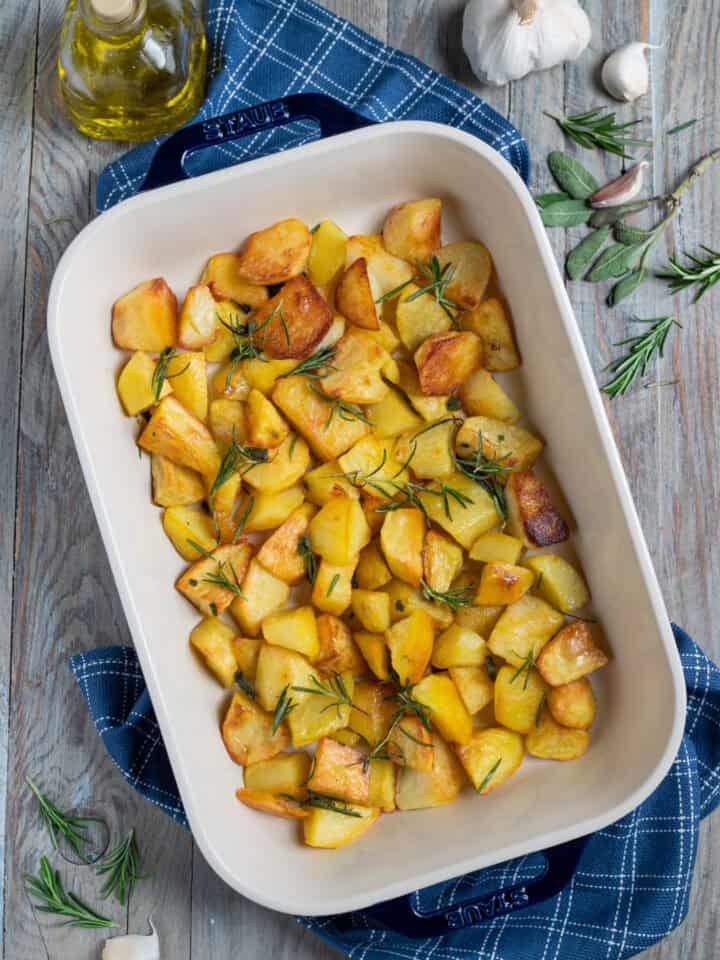
Baked potatoes are a classic side dish of Italian cuisine, crunchy, fragrant and versatile, perfect for accompanying your second courses, both fish and meat, such as roast chicken.
The preparation is very simple, just cut the potatoes into cubes and cook them in the oven with the addition of some aromas until they obtain a golden crust on the outside while the inside remains soft and creamy. You can customize the side dish with the aromas you prefer such as paprika, aromatic herbs or chilli pepper if you like.
However, to obtain a perfect result, i.e. beautiful golden potatoes, crunchy on the outside and soft on the inside, there are some precautions to follow, starting with the choice of potatoes. I suggest you use red or yellow potatoes but absolutely not new ones as they are quite watery, while yellow or red potatoes will become nice and crunchy when cooked. It is also better to avoid white potatoes which are quite floury and tend to fall apart.
Ingredients
- Potatoes (yellow or red)1 kg
- Extra virgin olive oil to taste
- Rosemary 2 sprigs
- Sage 6 leaves
- Salt to taste
Procedure
Wash the potatoes under running water, then cut them in half and finally into wedges (or alternatively into cubes of about 3 centimetres). The important thing is that the segments (or cubes) are not too thick (otherwise they risk remaining raw internally) and that they are all more or less the same size, to ensure even cooking. Place the potatoes, once cut, in a bowl full of cold water to avoid oxidation and allow excess starch to be eliminated, which will help you obtain greater crunchiness during cooking.

Season the potatoes with sage leaves, rosemary needles, oil and salt; place the potatoes on an oiled baking tray and cook everything at a temperature of 200° in the electric oven in static mode for about 50 minutes or until all the potatoes have been browned and golden brown.

Remember to turn the potatoes from time to time to ensure even cooking. As soon as your potatoes are cooked and well roasted, remove them from the oven and serve them piping hot: enjoy your meal!
Notes & advice
*If you like, you can cook the potatoes with the peel, to give a more rustic touch: I recommend that, if you opt for the peel, make sure to wash the potatoes very well under plenty of fresh running water to eliminate any residue.
*If you want, you can blanch the already cut potatoes before baking them, in order to shorten the time spent in the oven. Be careful, they must not become boiled potatoes! A few minutes is more than enough.
In addition to the classic rosemary and sage, I also present other alternatives to season your potatoes and make them even tastier:
-
- A mix of aromatic herbs consisting of bay leaves, garlic, chilli pepper and ground black pepper.
- Fresh aromatic herbs (but if you can’t find them, you can opt for the dried ones that you find in all supermarkets.) chopped together with the garlic
Smoked or sweet
- Paprika, which can give an extra touch of flavor and colour.
Frequently asked questions
Why is it recommended to blanch potatoes?
It serves to make them softer inside and to shorten cooking times.
Can I cook potato wedges this way?
You can do this, but if they are very large you will need to lengthen the cooking time.
Can I peel the potatoes the night before and then cook them the next day?
I don’t recommend it, the ideal is to peel the potatoes and cook them immediately so that they don’t take on air and darken.
What is the point of soaking potatoes?
It serves to avoid oxidation and allow the elimination of excess starch, which will help you obtain crispier baked potatoes.
What is the purpose of blanching (or blanching) potatoes?
Blanching the potatoes helps to reduce cooking time in the oven and ensure that the inside is soft and well cooked.
What oil can I use for baked potatoes?
I advise you to always use extra virgin olive oil.
Conservation
Baked potatoes should be consumed immediately as soon as they come out of the oven as they lose their crunchiness and goodness characteristics in a short time. They are not suitable for freezing.
Curiosities
Imported from Peru and cultivated since ancient times, the potato arrived in Europe at the hands of the Spanish in 1536. Its diffusion, however, initially encountered a certain resistance from wary European farmers, so much so that it only definitively established itself around the 18th and 19th centuries. The stratagem devised by Parmentier, a famous French pharmacist and agronomist, is curious: to spread its consumption, he sent soldiers to guard entire potato fields from dawn to dusk. Who knows what precious treasure they had to guard! Overnight, the farmers began to steal these tubers, which thus became part of their daily diet!